
From Playing it Safe to Putting Myself Out There
On staying in the work long enough for good ideas to take shape
Right after high school, I packed up my sketchbooks, art bin, and big dreams and headed off to design school. It was a perfect plan—get some experience in the field and one day run my own design studio. Creating bold, playful, eye-catching work—the kind people noticed, remembered, and felt something about. Owning something that was mine, the way my parents had owned their work.
I grew up on a farm in southwest Michigan, watching my dad run his own business and my mom support it in a hundred quiet ways. They worked hard, but they had freedom. They were building something of their own. I wanted that too—only instead of cornfields, I imagined myself surrounded by logos, packaging, and projects stacked high on my desk.
But on the way to that dream, I met some intruders.
The First Intruder: Comparison
Comparison first showed up in class one afternoon when my professor dimmed the lights and rolled in the slide projector. The screen filled with the bold, beautiful work of Charles Spencer Anderson—posters, packaging, logos, each one more impressive than the last.
As the professor gushed, a familiar doubt crept in: You’ll never be that good. Why even try?
I didn’t know yet how to put that work into context—or how to separate admiration from self-judgment. I couldn’t see that the designers we studied had been honing their craft for decades. All I could see was the distance between their work and my beginner’s attempts.
I see this same gap all the time now—with kids, creatives, and small business owners comparing early drafts to someone else’s finished product. We rarely compare from a fair starting line. And when comparison shows up too early, it keeps ideas from ever getting off the ground.
I’ve since learned I wasn’t alone. More than half of graphic designers leave the profession within two years—burned out or discouraged by impossible standards. At the time, I didn’t know that. I only knew my work felt small next to the legends.
The Second Intruder: Perfectionism
Perfectionism didn’t show up as attention to detail. It showed up as fear.
It wasn’t about tidy lines or polished layouts—it was about control. This idea can’t fail. Everyone has to like it. I can’t get this wrong.
Not fear of messy work.
Not fear of experimentation.
Fear of being wrong.
Fear of falling short.
Fear of failing where others could see it.
What I understand now is that this isn’t a design problem—it’s a thinking problem.
I assumed good designers started with great ideas. What I didn’t realize was that rough ideas are how you get to strong ones. But when you don’t give yourself permission to be bad, you never get the chance to be great. The messy middle—the half-formed ideas, false starts, and almosts—isn’t a flaw in the process. It is the process.
That mindset followed me into my first jobs. Instead of pitching bold concepts, I stuck with work I knew I could deliver—projects that felt safe and predictable. It seemed practical at the time. In reality, it narrowed what was possible.
What I didn’t understand yet is that creativity isn’t about perfection—it’s about thinking. It’s problem-solving, experimenting, and connecting ideas in new ways.
The Third Intruder: The Critic
The Critic was quieter but persistent.
It showed up whenever I considered sharing an idea and asked one simple question: What will people think?
That question has a way of stopping ideas before they fully form. It pulls attention away from curiosity and toward imagined judgment. Over time, it trains you to aim for acceptable instead of bold. It convinces you to stay on the sidelines just when the work needs to be tested and seen.
The Critic is why so many of us—kids and adults alike—hold back creatively. Fear of what people will say keeps ideas private and unfinished, even though that early, imperfect stage is where real progress happens.
The Detour
I didn’t realize it then, but my education prepared me for the tools of the trade—not the mental side of creativity. I was technically capable, but the intruders were louder than my confidence.
Looking back, I see this as a common detour—not a failure, but a loss of trust in how creativity actually works.
I poured my energy into other paths and adventures, convincing myself I’d outgrown the original dream.
Here’s what I know now: the dream never disappeared. It just waited.
It waited through exciting jobs and lifelong friendships at the Detroit Tigers and Chicago Cubs. It waited while I built a life—getting married, staying home with my two daughters, and filling our days with playgrounds and imagination. My world grew in countless meaningful ways, even as the idea of running my own studio quietly waited.
The Comeback
What changed wasn’t my talent.
It wasn’t my timing.
It wasn’t even the intruders.
What changed was my willingness to question them.
Some of that came with age—the perspective that comes from living life. Some of it came from finally understanding that good ideas don’t arrive fully formed—they’re shaped through trying, adjusting, and staying in the work longer than feels comfortable. Courage isn’t having confidence from the start. It’s choosing to stay in the messy middle.
Later, I did the thing I’d wanted all along. I built my own studio—not a perfect one and not one that looks like anyone else’s, but mine.
That clarity now shows up in how I work—with ideas, with clients, and with creative problem-solving every day.
I also did it for my daughters. I wanted them to see that even if you get knocked off course, you can come back—and that there’s no single timeline you have to match.
Early on, I thought perfection was the price of entry.
Now I know courage is.
Because that’s the real work of creativity—staying in it long enough for the good ideas to emerge.
I used to believe creativity was about talent or timing.
Now I know it’s about trying again.
And these days, whether I’m sketching a logo, brainstorming with a client, or helping my kids with a school project, I remind myself of one simple thing:
Choose the messy middle over playing it safe.
That’s where the good ideas live.
In my next post, I’ll share how this way of thinking shows up for small business owners—and how creative thinking can quietly change the way you approach decisions, problem-solving, and growth.
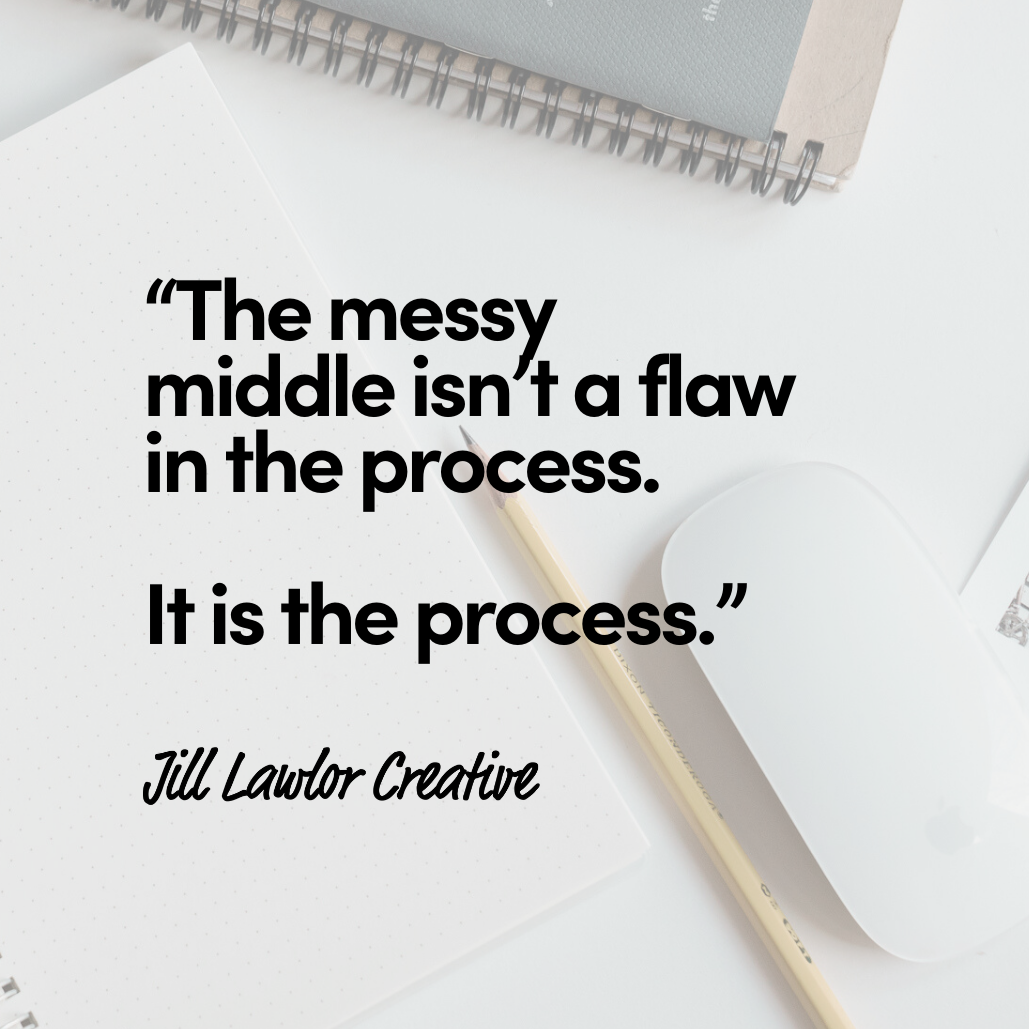
This is a conversation I’ll be continuing on LinkedIn—about playing it safe, the messy middle, and what it really takes to put your work out there. If this resonated, you’re welcome to join me there.
